
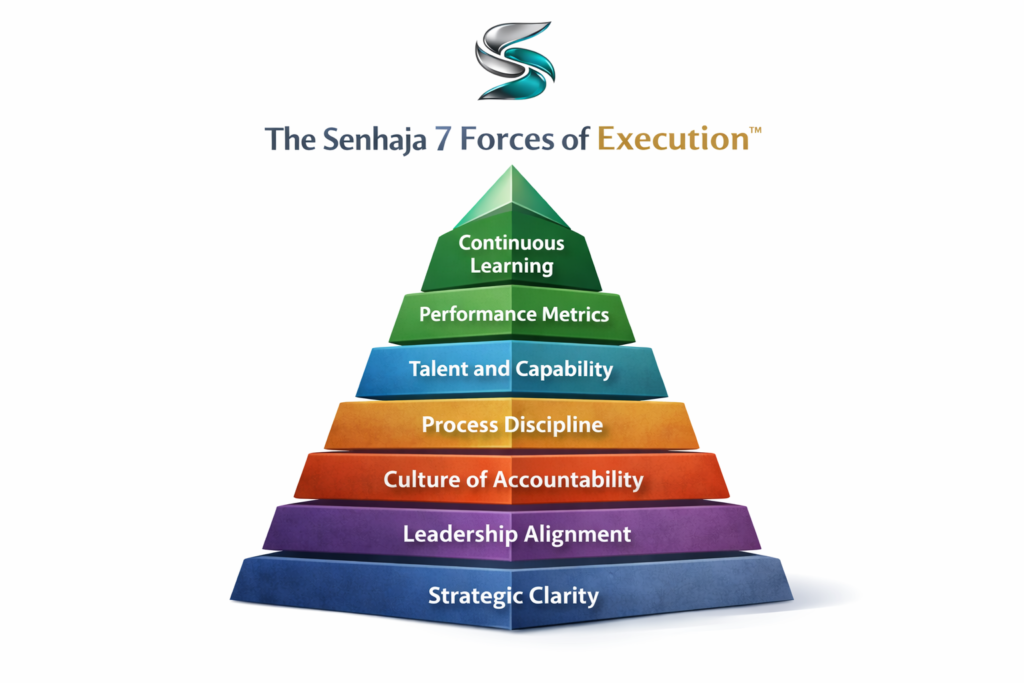
The Senhaja Execution Operating System™ (SEOS) is a proprietary strategic execution framework developed by Senhaja Group, designed to translate strategy into measurable results through seven integrated forces: Strategic Clarity, Leadership Alignment, Culture of Accountability, Process Discipline, Talent & Capability, Performance Metrics, and Continuous Learning.
Force 1: Strategic Clarity
Strategic clarity is the first and most foundational force of execution because it determines whether an organization is directing its energy toward meaningful outcomes or dissipating it across competing priorities. In today’s business environment, where complexity is increasing and speed is demanded, many organizations mistake motion for progress. Teams are busy, initiatives are launched, meetings are held, and dashboards are filled with activity, yet results remain inconsistent or underwhelming. The root cause is rarely effort, it is direction.
Strategic clarity is the disciplined act of narrowing ambition into a small number of decisive priorities that the organization can commit to and execute with focus. It requires leaders to make explicit trade-offs, to define what will be pursued and equally important, what will not. Without this force, organizations suffer from initiative overload, conflicting KPIs, and fragmented execution where departments optimize locally but fail collectively.
Achieving strategic clarity requires more than a well-written strategy document, it demands a structured process of decision-making, communication, and reinforcement. Leaders must move beyond broad aspirations and define concrete outcomes, supported by leading measures that signal progress before results are visible. When leaders deviate or introduce new initiatives without removing old ones, clarity erodes and execution weakens. This is why the discipline of “3 Wins, 3 Stops, and 3 Measures” becomes critical, it forces prioritization, eliminates dilution, and creates a rhythm of accountability.
Ultimately, strategic clarity is not a one-time exercise, it is a continuous leadership responsibility. It must be revisited, communicated, and reinforced through governance routines, performance reviews, and daily management practices. Organizations that master this force experience a profound shift, meetings become focused, decisions become faster, teams become aligned, and results become predictable. In contrast, organizations that neglect it remain trapped in cycles of effort without impact. Strategic clarity is not just the starting point of execution, it is the force that makes all other forces possible.
Force 2: Leadership Alignment
Leadership alignment is the force that transforms strategy from an intellectual exercise into a coordinated organizational movement. While strategic clarity defines what matters most, leadership alignment ensures that those priorities are interpreted, reinforced, and executed consistently across all levels of leadership. In many organizations, misalignment is subtle yet destructive. Executives may agree in formal meetings but communicate different messages through their decisions, incentives, and day-to-day behaviors.
Leadership alignment eliminates this friction by establishing a unified voice, a shared interpretation of strategy, and consistent decision-making principles. It ensures that leaders are not only aligned in words but also in actions, priorities, and consequences. When alignment is strong, the organization moves with coherence, decisions accelerate, and teams gain confidence in the direction they are following.
Achieving leadership alignment requires deliberate structure, not assumption. It begins with aligning on three critical dimensions, strategic intent, KPI definition, and decision rules. Strategic intent ensures that all leaders share the same understanding of what success looks like and why it matters. KPI definition aligns leaders on how success will be measured, preventing conflicting metrics that drive competing behaviors. Decision rules establish how trade-offs will be made, particularly under pressure, ensuring consistency when priorities collide.
Leadership alignment also requires ongoing calibration through structured forums, where leaders openly challenge assumptions, resolve disagreements, and reinforce shared commitments. Importantly, alignment does not eliminate disagreement, it channels it productively. High-performing leadership teams debate rigorously but commit collectively, presenting a unified front to the organization. This discipline builds trust, reduces ambiguity, and accelerates execution. When leadership alignment is present, organizations experience clarity in communication, consistency in decisions, and strength in execution. When absent, even the strongest strategy will fail under the weight of internal contradiction.
Force 3: Culture of Accountability
A culture of accountability is the force that ensures strategy is not only planned but owned, measured, and delivered. It is the difference between organizations that talk about results and those that consistently achieve them. In many environments, accountability is misunderstood as blame or control, leading to resistance and disengagement. True accountability, however, is about ownership with clarity, where individuals and teams understand their responsibilities, commit to measurable outcomes, and take proactive action to deliver results. Without this force, organizations fall into patterns of diffusion, where responsibilities are shared but ownership is unclear. Committees replace individuals, escalations replace decisions, and missed commitments are rationalized rather than corrected. This creates a culture where execution slows, trust erodes, and performance becomes unpredictable. A strong culture of accountability reverses this dynamic by establishing clear ownership for every priority, supported by transparent metrics and structured follow-through. It creates an environment where commitments are taken seriously, progress is tracked visibly, and recovery actions are expected when results fall short.
Building this culture requires systems and behaviors that reinforce ownership at every level. Each strategic priority must have a single accountable owner, supported by defined KPIs and clear expectations. Leading indicators must be tracked regularly to provide early visibility into performance, allowing teams to adjust before outcomes are impacted.
Equally important is the discipline of recovery, where missed targets trigger immediate corrective actions rather than delayed responses. Leaders must model this behavior by holding themselves accountable and reinforcing it across the organization. Over time, this creates a culture where accountability is not enforced but expected, where individuals take pride in ownership, and where execution becomes reliable. A culture of accountability transforms strategy into action by ensuring that every commitment has a name, a measure, and a follow-through.
Force 4: Process Discipline
Process discipline is the force that stabilizes execution and enables organizations to perform consistently under pressure. While strategy defines direction and accountability ensures ownership, process discipline ensures that work is executed in a structured, repeatable, and reliable manner. In many organizations, performance depends heavily on individual effort and experience, creating variability that undermines results. Processes are loosely defined, handoffs are unclear, and outcomes depend on who is involved rather than how the work is designed. This leads to inefficiencies, errors, and a constant reliance on firefighting. Process discipline addresses this by establishing clear workflows, defined standards, and consistent execution practices. It reduces variability, improves predictability, and frees up capacity for innovation and improvement. Without it, organizations remain trapped in reactive cycles, where problems are addressed repeatedly but rarely resolved at their root.
Implementing process discipline requires a focus on standardization, clarity, and continuous improvement. Standard work defines the best known way to perform tasks, ensuring consistency across teams and locations. Defined handoffs clarify responsibilities between functions, reducing delays and miscommunication. Escalation paths provide a structured way to address issues quickly, preventing small problems from becoming major disruptions. Preventive structures, such as maintenance schedules and quality checks, reduce the likelihood of failure before it occurs.
Process discipline also supports scalability, allowing organizations to grow without losing control. As operations expand, disciplined processes provide the foundation for maintaining performance and managing complexity. Ultimately, process discipline transforms execution from unpredictable effort into controlled performance, enabling organizations to deliver results consistently and efficiently.
Force 5: Talent & Capability
Talent and capability represent the human and organizational capacity required to execute strategy effectively. While processes and systems provide structure, it is people who bring execution to life through their skills, decisions, and actions. This force ensures that the organization’s capabilities are aligned with its strategic ambitions. In many cases, execution challenges are not due to flawed strategies but to gaps in capability, where the demands of the strategy exceed the organization’s readiness to deliver. These gaps manifest as delays, errors, and over-reliance on a few individuals, creating bottlenecks and limiting scalability. Talent and capability alignment addresses this by ensuring that the organization has the right skills, authority, capacity, and tools to execute its priorities. It recognizes that execution is not only about what needs to be done but also about who is doing it and how well they are equipped to succeed.
Developing this force requires a comprehensive approach to building and sustaining capability. Skills must be continuously developed (Force 7) through training, coaching, and experience. Authority must be clearly defined, enabling individuals to make decisions without unnecessary delays. Capacity must be managed to ensure that workloads are realistic and sustainable. Tools and systems must support efficiency and effectiveness, enabling teams to perform at their best.
Organizations must also identify and address capability gaps proactively, ensuring that talent development keeps pace with strategic evolution. When talent and capability are aligned, execution becomes confident, efficient, and scalable. When misaligned, organizations experience stress, delays, and inconsistent performance. This force ensures that the organization is not only willing but also able to execute its strategy successfully.
Force 6: Performance Metrics
Performance metrics are the force that translates strategy into measurable outcomes and actionable insights. They provide the visibility needed to understand whether the organization is progressing toward its goals and where adjustments are required. In many organizations, metrics are abundant but ineffective, focusing heavily on lagging indicators that reflect past performance rather than predicting future outcomes. This creates a reactive environment where issues are identified only after they have impacted results. Performance metrics, when designed effectively, shift this dynamic by incorporating leading indicators that provide early signals of performance, enabling proactive decision-making. They align the organization around shared measures of success and create a common language for evaluating progress. Without this force, organizations operate with limited visibility, making decisions based on incomplete or outdated information.
Building effective performance metrics requires a structured approach that integrates multiple layers of measurement. Outcome metrics capture the ultimate results of the strategy, such as revenue growth, customer satisfaction, or operational efficiency. Operational drivers focus on the activities that influence these outcomes, providing insight into the effectiveness of execution. Behavioral signals track the actions and behaviors that support performance, ensuring alignment with desired practices. Strategic health indicators provide a broader view of organizational sustainability and resilience.
The key is to ensure that metrics are not only measured but also used, through regular review cycles and decision-making processes. When performance metrics are well-designed, they enable organizations to anticipate challenges, adjust strategies, and maintain momentum. They transform data into insight and insight into action, driving continuous improvement and sustained performance.
Force 7: Continuous Learning
Continuous learning is the force that ensures organizations evolve, adapt, and improve over time. It is the mechanism through which experiences are translated into insights and insights into better execution. In dynamic business environments, where conditions change rapidly, the ability to learn and adapt becomes a critical competitive advantage. Without continuous learning, organizations repeat the same mistakes, miss opportunities for improvement, and struggle to keep pace with change. This force embeds structured reflection into the organization’s operating rhythm, ensuring that learning is not incidental but intentional. It creates a culture where feedback is valued, experimentation is encouraged, and improvement is continuous. Continuous learning transforms execution from a static process into a dynamic capability, enabling organizations to refine their strategies and operations based on real-world experience.
Implementing continuous learning requires establishing structured processes for reflection and improvement. This includes regular reviews, such as monthly retrospectives and quarterly assessments, where teams analyze performance, identify root causes, and develop improvement actions. It also involves capturing and sharing knowledge across the organization, ensuring that lessons learned in one area benefit others.
Continuous learning also requires a mindset shift, where failures are viewed as opportunities for growth rather than setbacks. Leaders play a critical role in fostering this mindset by encouraging openness, supporting experimentation, and recognizing improvement efforts. When continuous learning is embedded in the organization, it drives innovation, resilience, and sustained performance. It ensures that the organization not only executes effectively but also evolves continuously, maintaining its relevance and competitiveness in a changing world.